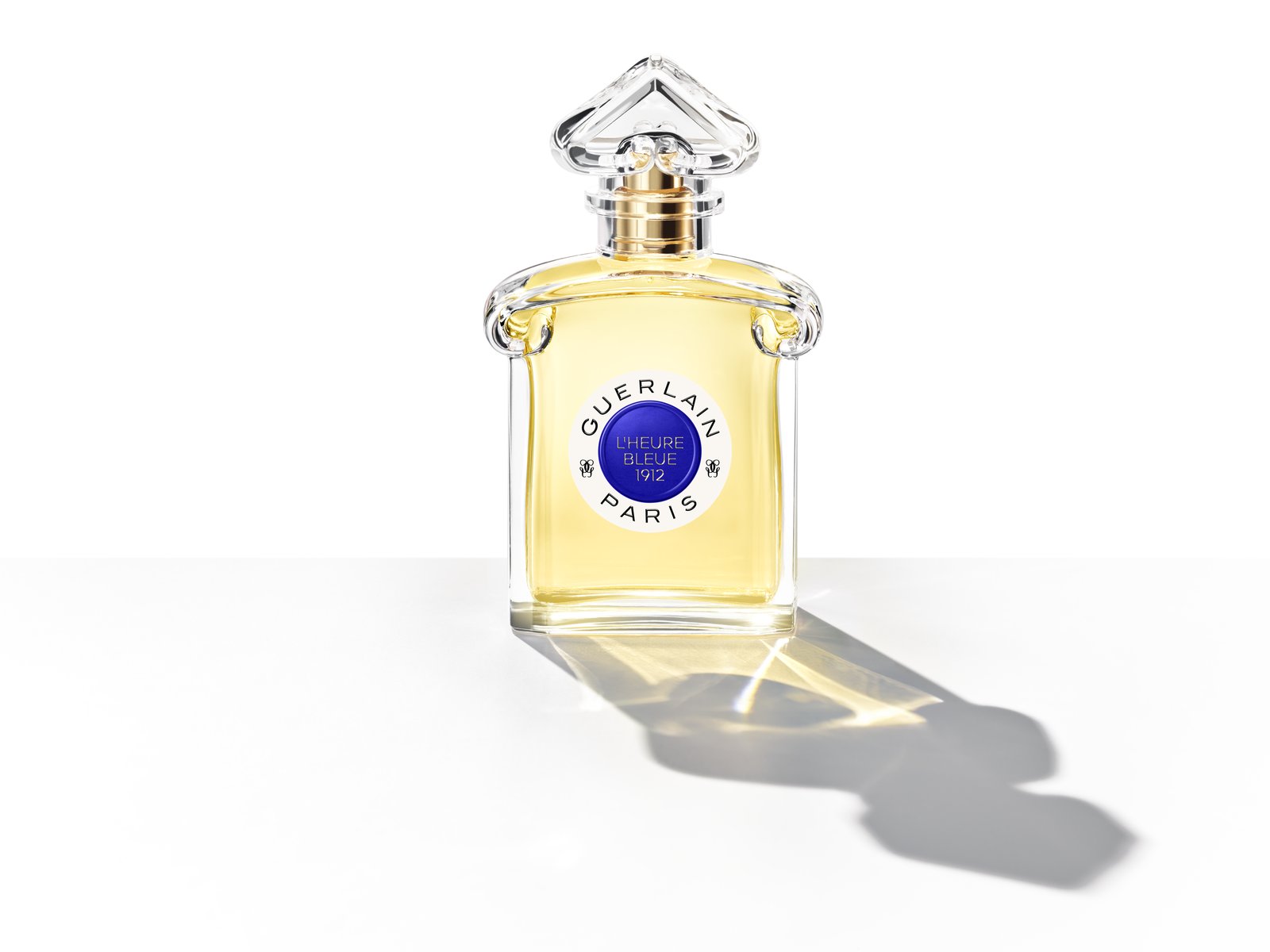
Quick answers
Year and family
1912 · Powdery oriental floral
Olfactory signature
A powdery oriental floral that renders the Parisian twilight in heliotrope, anise and iris, a deliberately melancholic statement made on the eve of the First World War.
Story
L'Heure Bleue was launched in 1912 by Guerlain, the perfume house founded in Paris (France) in 1828 by Pierre-François-Pascal Guerlain. By the early 1910s the house had passed to Jacques Guerlain, third-generation perfumer of the family, who would later sign Mitsouko in 1919 and Shalimar in 1925. L'Heure Bleue arrived as his first major statement of the period and set the powdery oriental floral register that the house would refine for the next two decades.
The name borrows a Parisian metaphor. L'heure bleue refers to the brief interval between sunset and night when the sky turns a saturated deep blue, the moment when the city softens and lamps come on. Jacques Guerlain framed the perfume as the olfactory translation of that twilight hour rather than as a technical exercise. The reference, popular in Belle Époque writing and painting, anchored the composition in a melancholic Parisian aesthetic two years before the First World War swept the period away.
The technical rupture was the dosage of heliotropin, the synthetic molecule that delivers the powdery almond-vanilla facet of heliotrope. The material had been available since 1869 but was generally used in modest accents. Jacques Guerlain placed it at the structural center of the composition, supported by iris, violet and a balsamic vanilla-benzoin base, and counterbalanced by an unusual anise overture on top. The result reads as a single dense atmosphere rather than as a layered progression, and it opened the powdery oriental floral lineage that runs through Après l'Ondée, Vol de Nuit and later powdery niche compositions.
The commercial reception was strong and the longevity remarkable. L'Heure Bleue became one of the personal signatures of the early twentieth century, worn by figures of the Parisian artistic and intellectual scene, and remains in production more than a century later. The formula has been reformulated several times to comply with IFRA restrictions on certain musks and on the maximum dosage of heliotropin, so that the modern Eau de Parfum reads as a softer, less anise-forward version of the 1912 extrait preserved at the Osmothèque in Versailles (France). Luca Turin and Tania Sanchez awarded the composition five stars in Perfumes: The Guide, calling it one of the most poetic statements in the Guerlain catalogue. The pyramid and composition below describe the modern eau de parfum, while the Story section above recounts the 1912 original.
Olfactory pyramid
The pyramid below reflects the modern eau de parfum, reformulated for IFRA compliance; the 1912 original is described in the Story section above. The architecture of L'Heure Bleue is a three-tier pyramid in which the powdery heart of heliotrope, iris and violet sets the dominant register. The unusual anise overture and the long balsamic vanilla drydown frame that heart on either side. Notes documented on the Guerlain official product page.
Top
Anise, aldehydescool melancholic opening
Bergamot, coriander, nerolihesperidic lift
Heart
Heliotrope, violet, irispowdery signature core
Ylang-ylang, jasmine, rose, orange blossom, carnationclassical floral support
Base
Vanilla, benzoin, tonkabalsamic powdery drydown
Iris, musklong velvety persistence
Evolution on skin is slow and atmospheric. The anise and aldehyde opening occupies the first fifteen minutes, cool and faintly metallic against the bergamot. The powdery heart of heliotrope, iris and violet then takes over and stays for several hours, supported by a soft floral chorus. The vanilla and benzoin drydown extends past eight hours on skin and well beyond on textile, where the powdery character lingers as a velvet trace.
Composition and heliotropin
The olfactory signature of L'Heure Bleue rests on a single material used at an unusually high dose. Heliotropin, also called piperonal, is a synthetic molecule with a sweet, powdery, almond-vanilla scent that recalls the heliotrope flower without ever reproducing it literally. Jacques Guerlain placed it at the structural center of the heart and let it set the entire atmosphere of the composition. The choice broke with the bright florals that dominated 1900s perfumery and proposed a darker, more contemplative register.
The technical architecture articulates that heart through carefully chosen counterparts. Iris and violet reinforce the powdery register, while ylang-ylang, jasmine and orange blossom add a soft floral chorus that prevents the composition from reading as a mono-material study. The anise top note, derived from anethole, lifts the opening with a cool, faintly metallic edge that is rarely seen in feminine perfumery of the period. The vanilla and benzoin base, supported by tonka and a discreet musk, anchors the entire structure in a balsamic drydown that prolongs the powdery character for many hours.
The character that results is poetic and singular. Poetic, because the composition translates a Parisian twilight rather than a flower or a place. Singular, because L'Heure Bleue was conceived from the outset as a personal signature for a wearer, not as a seasonal or contextual fragrance. That dual ambition explains both its lasting commercial success and the polarization it provokes among contemporary readers, who either embrace the powdery oriental register or find it too dense for daytime wear.
L'Heure Bleue is the moment when perfumery learned to write in melancholic tones. Everything powdery and twilight-flavored that follows reads as a footnote to this 1912 statement.
Identity card
Family
Powdery oriental floral, founding composition of the lineage in French perfumery
Typical longevity
8 to 12 hours on skin in the Eau de Parfum, more than 24 hours on textile
Sillage
Generous in the first hours, soft and powdery through the long drydown
Audience
Marketed for women by Guerlain since 1912, with a growing contemporary unisex reading
Cultural legacy and reformulations
L'Heure Bleue occupies a particular place in the cultural memory of French perfumery. The composition is associated with the Belle Époque, with the literary salons of pre-1914 Paris (France) and with a certain melancholic Parisian elegance that the First World War would interrupt. Writers, actresses and figures of the artistic scene of the early twentieth century adopted it as a personal signature, and the perfume retained that intellectual aura through every later decade. Guerlain has continued to promote the composition as a poetic flagship rather than as a mass-market item.
The reformulation history matters when reading the modern juice. The original 1912 extrait, preserved at the Osmothèque in Versailles (France), carries a denser anise opening, a more animalic musk base and a heavier dose of materials later restricted by IFRA. Successive reformulations from the 1990s onward adjusted the levels of oakmoss, of certain musks and of heliotropin itself, the upper limits of which were lowered as the molecule became regulated. The modern Eau de Parfum is consequently a softer, more transparent reading of the original, while the current Parfum concentration remains the closest commercial approximation of the 1912 statement.
The lineage that descends from L'Heure Bleue is wide. Après l'Ondée (Guerlain, 1906), the slightly earlier sister composition, shares the powdery heliotrope-violet register without the anise overture. Vol de Nuit (Guerlain, 1933) by Jacques Guerlain prolongs the iris-vanilla architecture in a darker, more leathery key. Decades later, Iris Poudre by Pierre Bourdon for Frédéric Malle (2000) revisits the powdery floral genre with a niche perfumery sensibility, and Mitsouko (Guerlain, 1919) and Shalimar (Guerlain, 1925) extend the same compositional ambition into chypre and oriental ambery territories.
| Perfume | House · year | Why related |
|---|
| Après l'Ondée | Guerlain · 1906 | Older sister composition by Jacques Guerlain; shares the powdery heliotrope-violet register without the anise overture. |
| Mitsouko | Guerlain · 1919 | Next major Jacques Guerlain composition; chypre architecture sharing the contemplative Guerlain signature. |
| Shalimar | Guerlain · 1925 | Founding oriental ambery by the same perfumer; the third panel of the Jacques Guerlain trio. |
| Habanita | Molinard · 1921 | Powdery oriental contemporary; same 1920s French wave of melancholic compositions. |
| Iris Poudre | Frédéric Malle · 2000 | Niche reading of the powdery floral genre signed by Pierre Bourdon; direct descendant of the L'Heure Bleue lineage. |
When and where to wear
Within classic French perfumery, L’Heure Bleue is prized as a melancholic and poetic scent. Its aniseed and powdery signature makes it a personal, intellectual fragrance rather than a crowd pleaser. The benchmarks below follow the reading of a powdery oriental floral worn close to the skin.
Wear references
Temperatures
At its best between 5 °C and 22 °C. The powdery warmth reads best in cool air and can feel dense in strong heat.
Moment
More at ease in the late day and evening, when its contemplative trail has room to unfold.
Contexts
Private views, hushed dinners, the theatre: excellent. A scent for settings that reward presence over projection.
Dosage
Evening: two sprays are enough; the sillage is tenacious and carries on fabric.
Seasonal fit
| Season | Fit | Critical notes |
|---|
| Spring | ★★★☆ | Good fit, the powdery heart stays legible in mild air. |
| Summer | ★★☆☆ | Its density can turn heavy in strong heat. |
| Autumn | ★★★★ | Its season of choice, when the aniseed and iris fully bloom. |
| Winter | ★★★★ | Excellent, the balsamic base reaches its full breadth. |
Context fit
| Setting | Fit | Wearing recommendation |
|---|
| Office | ★★☆☆ | The sillage can feel too present in shared spaces. |
| Formal evening | ★★★★ | Its reference setting. |
| Theatre and opera | ★★★★ | A historic context for this contemplative perfume. |
| Intimate dinner | ★★★★ | Excellent at close range. |
| Sport | ★☆☆☆ | Unsuited to the setting. |
| Private view | ★★★★ | A context of choice. |
Similar perfumes
Five perfumes share a kinship with L’Heure Bleue through the powdery oriental floral lineage of the Guerlain school.
| Perfume | House · year | Why it is close |
|---|
| Mitsouko | Guerlain · 1919 | A Guerlain fruity chypre from the same classic French school. |
| Shalimar | Guerlain · 1925 | A Guerlain amber oriental from the same house. |
| Jicky | Guerlain · 1889 | The founding Guerlain forerunner, from the same lineage. |
| Habanita | Molinard · 1921 | A contemporary animalic oriental floral. |
| Iris Poudre | Frédéric Malle · 2000 | A niche iris by Pierre Bourdon, a modern rereading. |
Frequently asked questions
Who composed L'Heure Bleue?01
Jacques Guerlain, third-generation perfumer of the Guerlain family and one of the major French perfumers of the twentieth century, composed L'Heure Bleue in 1912. He later signed Mitsouko in 1919 and Shalimar in 1925, completing a trio of founding compositions of modern French perfumery.
Why is the perfume called L'Heure Bleue?02
The name evokes the Parisian twilight, the short interval between sunset and night when the sky turns deep blue. Jacques Guerlain framed the composition as the olfactory translation of that melancholic, contemplative hour, a Belle Époque metaphor that has accompanied the perfume since 1912.
What is the olfactory family of L'Heure Bleue?03
Powdery oriental floral, structured around an anise and aldehyde opening, a powdery heart of heliotrope, iris and violet, and a balsamic base of vanilla, benzoin, tonka and musk.
Why is L'Heure Bleue historically important?04
Because it uses heliotropin as a first-class material at the heart of the composition, at a dosage unprecedented in 1912 luxury perfumery, and assumes a deliberately melancholic register against the bright florals of the period. Jacques Guerlain opened the powdery oriental floral lineage that runs through Vol de Nuit and later niche compositions.
How long does L'Heure Bleue last?05
Between 8 and 12 hours on skin in the modern Eau de Parfum, with a long powdery vanilla drydown that lingers on textile well past 24 hours. The vintage extrait reportedly holds longer still.
When should you wear L'Heure Bleue?06
Best between 5 °C and 22 °C, mainly in autumn and winter, in late afternoon or evening. The composition fits intimate dinners, theater and gallery openings better than open-plan offices.
What versions of L'Heure Bleue exist?07
Several concentrations coexist: Eau de Parfum, Parfum (extrait) and historical Eau de Toilette. The original formula remains in production with successive IFRA adjustments since the 1990s, which have softened the anise opening and the musk base.
Is L'Heure Bleue a women's or men's perfume?08
Guerlain has marketed L'Heure Bleue as a feminine perfume since 1912. A growing contemporary audience reads it as a unisex powdery oriental floral, in line with the broader shift toward gender-flexible classics in niche perfumery.
What is the olfactory signature of L'Heure Bleue?09
The pairing of an anise-aldehyde opening and a powdery heliotrope-iris heart, anchored by a balsamic vanilla-benzoin drydown. Jacques Guerlain framed it as an olfactory evocation of the Parisian twilight, deliberately at odds with the bright florals of the Belle Époque.
What perfumes are similar to L'Heure Bleue?10
Five compositions share a kinship without being copies:
Après l'Ondée by Guerlain (1906),
Mitsouko by Guerlain (1919),
Shalimar by Guerlain (1925),
Habanita by Molinard (1921) and
Iris Poudre by Pierre Bourdon for Frédéric Malle (2000).
Sources
Published 23 May 2026 · Updated 15 May 2026 · Last fact check: 15 May 2026 (corrections validated by Guerlain) · Osmetheca