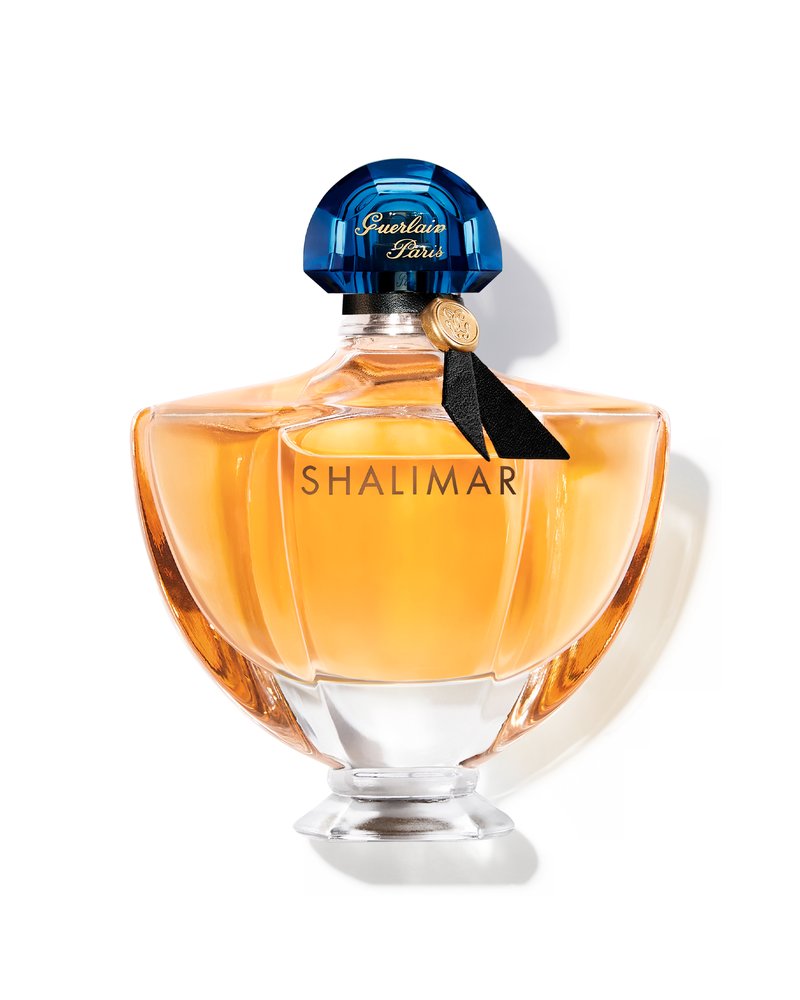
Quick answers
Year and family
1925 · Oriental ambery
Olfactory signature
The olfactory profile of Shalimar articulates a dramatic contrast between sparkling citrus on top and dense ambery vanilla in the heart and base. The opening lands immediately through bergamot and lemon, a luminous citrus burst that briefly recalls the great Guerlain colognes.
Story
Shalimar was launched in 1925 by Guerlain, the perfume house founded in Paris (France) in 1828 by Pierre-François-Pascal Guerlain. By the mid-1920s the house had passed to Jacques Guerlain, third-generation perfumer of the family, who had already signed L'Heure Bleue in 1912 and Mitsouko in 1919. Shalimar arrived as his third major statement and quickly became the commercial cornerstone of the Guerlain catalog.
The name comes from the Shalimar Gardens of Lahore (Pakistan), a Mughal pleasure garden built in the seventeenth century by emperor Shah Jahan for his wife Mumtaz Mahal, the same ruler who later commissioned the Taj Mahal in Agra (India). Jacques Guerlain seized on that romantic narrative anchor and built the entire promotion of the perfume around it, framing Shalimar as the olfactory translation of a Mughal love story rather than as a technical exercise. The reference has accompanied every advertising campaign for the perfume since 1925.
The technical rupture was the use of synthetic vanillin at a dose unprecedented in luxury perfumery. The molecule, isolated commercially in 1874 and refined as ethylvanillin in 1894, had been available for decades but was generally used in modest quantities. Jacques Guerlain placed it at the structural center of the composition, building a contrast between sparkling citrus on top and dense vanilla in the heart and base. That single decision opened the entire oriental ambery genre that defined Western luxury perfumery from the 1920s through the 1980s (Perfumes: The Guide by Luca Turin and Tania Sanchez, Bois de Jasmin essay on Guerlinade architecture).
The commercial reception was immediate and the longevity exceptional. Shalimar became one of the great feminine signatures of twentieth-century French perfumery and remains in production almost a century later, with periodic reformulations to comply with IFRA restrictions on certain musks and animalic materials. Luca Turin and Tania Sanchez awarded the composition five stars in Perfumes: The Guide, describing it as the founding oriental against which every later attempt at the genre has been measured. The olfactory pyramid and profile below describe the version sold today, adjusted for IFRA compliance while preserving the original vanillic signature; the 1925 creation is recounted in the Story section above.
Olfactory pyramid
The pyramid below reflects the version currently on the market, adjusted over the decades for IFRA compliance; the 1925 original is described in the Story section above. The architecture of Shalimar is a textbook three-tier pyramid, but with a heart vanilla so dominant that the composition reads as a single statement rather than a layered progression. Notes documented on the Guerlain official product page.
Top
Bergamot, lemonbright citrus opening
Mandarinluminous fruity facet
Heart
Irispowdery orris, the Guerlain signature
Jasmine, rose, patchouliflorals over an earthy base
Base
Vanillaethylvanillin, the central signature of Shalimar
Tonka bean, opoponax, incenseambery balsamic core
Leather, civetanimalic drydown
Evolution on skin is theatrical. The citrus opening occupies the first twenty minutes, lighting the wrist with bergamot brightness. The vanilla heart then takes over and stays for several hours, supported by the powdery iris-jasmine floor. The ambery balsamic drydown extends past fifteen hours on skin and well beyond on textile.
Olfactory profile
The olfactory profile of Shalimar articulates a dramatic contrast between sparkling citrus on top and dense ambery vanilla in the heart and base. The opening lands immediately through bergamot and lemon, a luminous citrus burst that briefly recalls the great Guerlain colognes. Within minutes that brightness yields to the vanilla core, dosed at an intensity that, in 1925, no perfume in Western luxury had attempted. The transition between the two registers is one of the most recognizable dramatic effects in classical perfumery.
The distinctive signature rests on a bold compositional decision. Jacques Guerlain treated synthetic vanillin as a first-class material, dosed massively rather than added as a sweet accent, and built the entire architecture of the perfume around it. That choice opened the door to every twentieth-century oriental ambery composition that followed, from Habanita and Tabac Blond in the same decade to Opium, Coco and the entire gourmand lineage of the 1990s and 2000s. Shalimar therefore reads less as a single perfume than as the founding statement of a whole olfactory family (Perfumes: The Guide, Now Smell This).
The character that results is opulent and singular. Opulent, because the composition assumes a vanilla density that evokes Mughal gardens, heavy silks and warm oriental nights. Singular, because Shalimar was conceived from the outset as a personal signature for a wearer rather than as a seasonal or contextual fragrance. That dual ambition explains both its lasting commercial success and the rare polarization it provokes among contemporary readers, who either embrace the maximalist register or find it overwhelming.
Shalimar is the moment Western perfumery learned to think in ambery, vanillic terms at maximalist intensity. Everything oriental that followed is, in some measure, a reading of this 1925 statement.
Key characteristics
Family
Oriental ambery, founding composition of the category in Western perfumery
Typical longevity
10 to 15 hours on skin, 36 hours and beyond on textile
Sillage
Bold during the first hours, present through a long balsamic drydown
Audience
Marketed for women by Guerlain since 1925, with a growing contemporary unisex reading
When and where to wear
Within the oriental ambery family, Shalimar is a maximalist signature. Its vanilla balsamic density and long longevity reward careful context and dosage. The benchmarks below reflect widely reported wearing patterns for the perfume.
Wear references
Temperatures
Best between 5 °C and 18 °C; viable to 22 °C at reduced dose; avoid above 26 °C where the balsamic vanilla becomes heavy.
Moment
Late afternoon and evening in most contexts; daytime only when the wearer claims the perfume as a personal statement.
Contexts
Formal evening, theater, gala dinner, winter walk: excellent. Open-plan office, dense transit: avoid.
Dosage
Daytime: one discreet spray on the wrist. Evening: two sprays. Textile: hold back, the perfume settles deeply into wool and fur.
Seasonal fit
| Season | Fit | Critical notes |
|---|
| Spring | ★★☆☆ | Workable on cool days, dose carefully to avoid overwhelming the season. |
| Summer | ★☆☆☆ | The balsamic vanilla can feel oppressive in heat; reserve for cool air-conditioned evenings. |
| Autumn | ★★★★ | The reference season; the ambery vanilla reads at full amplitude. |
| Winter | ★★★★ | Excellent projection in cold air; the drydown sits beautifully on wool and fur. |
Context fit
| Setting | Fit | Wearing recommendation |
|---|
| Office | ★☆☆☆ | Mismatched: sillage too present and durable for shared professional spaces. |
| Formal evening | ★★★★ | Reference setting; two sprays, immediate signature effect. |
| Theater, opera | ★★★★ | Historical context of the perfume; the oriental ambery register fits perfectly. |
| Intimate dinner | ★★★☆ | Well suited to a low-lit restaurant; restrain in small unventilated rooms. |
| Sport | ★☆☆☆ | Mismatched: density incompatible with perspiration. |
| Winter walk | ★★★★ | A textbook pairing of weather, textile and material. |
Similar perfumes
Five compositions share an aesthetic kinship with Shalimar through the oriental ambery family or the bergamot-vanilla architecture. None is a duplicate; each reads as a descendant or a contemporary cousin.
| Perfume | House · year | Why related |
|---|
| Habanita | Molinard · 1921 | Oriental ambery contemporary of Shalimar; same French tradition of the vanillic balsamic oriental. |
| Tabac Blond | Caron · 1919 | Oriental leather contemporary of Shalimar; same French wave of 1920s orientals. |
| Opium | Yves Saint Laurent · 1977 | Oriental spicy signed by Jean Amic and Jean-Louis Sieuzac; spectacular contemporary extension of the oriental ambery register. |
| Coco | Chanel · 1984 | Oriental spicy signed by Jacques Polge; a woodier modernization of the oriental ambery genre. |
| Ambre Sultan | Serge Lutens · 1993 | Oriental ambery composition from niche perfumery, signed by Christopher Sheldrake; a modern rereading of the vanillic ambery signature. |
Frequently asked questions
Who composed Shalimar?01
Jacques Guerlain, third-generation perfumer of the Guerlain family and one of the major French perfumers of the twentieth century, composed Shalimar in 1925. He also signed L'Heure Bleue (1912) and Mitsouko (1919), two other founding compositions of modern perfumery.
Where does the name Shalimar come from?02
It refers to the Shalimar Gardens of Lahore (Pakistan), built in the seventeenth century by Mughal emperor Shah Jahan, the same ruler who commissioned the Taj Mahal in Agra (India) for his wife Mumtaz Mahal. The reference anchors the perfume in a romantic oriental narrative.
What is the olfactory family of Shalimar?03
Oriental ambery, structured around a massive dose of synthetic vanillin in the heart, sparkling bergamot and lemon on top, and a balsamic base of opoponax, tonka, leather and civet.
Why is Shalimar considered revolutionary?04
Because it uses synthetic vanillin as a first-class material at the heart of the composition, at a dose unprecedented in 1925 luxury perfumery. Jacques Guerlain opened the door to the entire twentieth-century oriental ambery family.
How long does Shalimar last?05
Between 10 and 15 hours on skin, with bold sillage in the first hours and an ambery balsamic drydown that can linger on textiles for more than thirty-six hours, sometimes more than five days on wool and fur.
When should you wear Shalimar?06
Best between 5 °C and 18 °C, mainly in autumn and winter, in late afternoon or evening. Avoid in shared professional environments.
What versions of Shalimar exist?07
Several concentrations coexist: Eau de Parfum, Parfum (extrait), Eau de Toilette, along with later variations such as Shalimar Souffle de Parfum (2014, lighter reading) and Shalimar Initial. The original formula remains in production with minor IFRA adjustments.
Is Shalimar a women's or men's perfume?08
Guerlain has marketed Shalimar as a feminine perfume since 1925. A portion of the male audience now wears it as part of the broader oriental ambery tradition, which does not rely exclusively on conventionally feminine materials.
What is the olfactory signature of Shalimar?09
The pairing of a sparkling citrus opening and a massive balsamic vanilla heart, anchored by a long animalic ambery drydown. Jacques Guerlain claimed an evocation of romantic oriental opulence, deliberately at odds with the classical floral discretion of his era.
What perfumes are similar to Shalimar?10
Five compositions share a kinship without being copies:
Habanita by Molinard (1921),
Tabac Blond by Caron (1919),
Opium by Yves Saint Laurent (1977),
Coco by Chanel (1984) and
Ambre Sultan by Serge Lutens (1993).
Sources
Published 22 May 2026 · Updated 15 May 2026 · Last fact check: 15 May 2026 (corrections validated by Guerlain) · Osmetheca