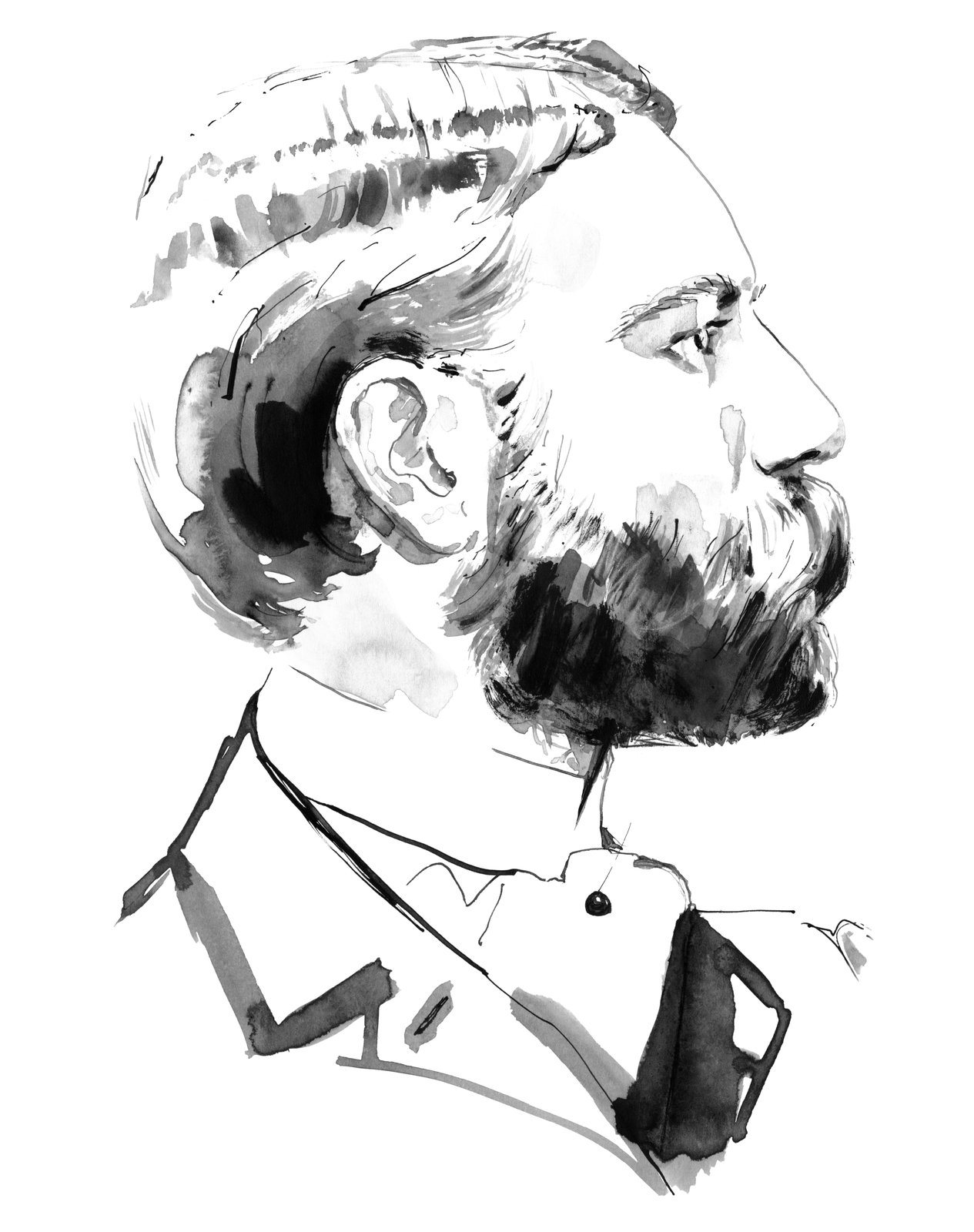
Quick answers
Biography and dynasty
Jacques Guerlain was born on 7 October 1874 in Colombes (France), the second son of Gabriel Guerlain and Clarisse Prevost, and died in Paris (France) on 2 May 1963 at the age of 88. He belonged to the third generation of the Guerlain dynasty, founded in Paris (France) in 1828 by Pierre-Francois-Pascal Guerlain, his grandfather. The house had already produced two figures of note before him: his grandfather Pierre-Francois, who built the brand around bespoke compositions for the imperial court, and his uncle Aime Guerlain, composer of Jicky in 1889.
His perfumery training began inside the family. His uncle Aime, who had no children, took Jacques on as an apprentice from the age of sixteen and groomed him as his successor. Jacques created his first composition, Ambre, in 1890, then completed an internship in the organic chemistry laboratory of Charles Friedel at the University of Paris, an unusual scientific grounding for a perfumer of his generation. He joined the family business officially in 1894 and became in-house perfumer of the house in 1898, a role he held continuously until 1947.
The Guerlain house at the turn of the twentieth century was a family enterprise structured around three brothers of the third generation. Jacques carried the olfactory direction; his elder brother Pierre Guerlain took the commercial and institutional side, and was later vice-president of the 1925 International Exposition of Modern Industrial and Decorative Arts in Paris. This division of roles, with one nose at the heart of the house, gave Jacques a freedom rare in his time: he composed almost the entire catalogue of Guerlain perfumes for nearly five decades.
From the 1950s onward, Jacques Guerlain began training his grandson Jean-Paul Guerlain as his successor, transmitting the family olfactory direction across a fourth generation. He still worked alongside Jean-Paul on Chant d'Aromes in 1962, a year before his death. A discreet man who never granted an interview, Jacques Guerlain was made Chevalier of the Legion of Honor and held the position of in-house perfumer longer than any of his successors at the house.
Olfactory signature
The olfactory signature of Jacques Guerlain rests on a single structural device: the Guerlinade. Inherited from his uncle Aime and formalized as a house code, the Guerlinade is an accord built on bergamot, rose, jasmine, iris, tonka bean and vanilla. It runs through almost every Guerlain composition of the first half of the twentieth century, from L'Heure Bleue to Shalimar, and gave the house a recognizable identity at a time when most fragrances were assembled around standalone ideas.
On top of this constant base, Jacques Guerlain explored three founding olfactory families. The oriental amber was perfected in Shalimar (1925), regarded as the archetype of the family, where a heavy dose of ethyl vanillin sits on top of the Guerlinade and bends it toward warmth and depth. The fruity chypre was opened by Mitsouko in 1919, structured around oakmoss and gamma-undecalactone, a synthetic peach lactone that founded a family explored by perfumers for the eighty years that followed. The powdered floral was set down in L'Heure Bleue (1912), an aniseed and violet composition wrapped in the soft heliotrope-vanilla cushion that defines the Guerlain idiom.
Jacques Guerlain belonged to the founding generation of twentieth-century French perfumery, alongside Francois Coty, Ernest Beaux at Chanel and Henri Almeras at Jean Patou. He stood out for two reasons. He composed across an unusually wide stylistic spectrum, from the soft pastels of Apres l'Ondee (1906) to the woody austerity of Vol de Nuit (1933). And he absorbed the synthetic revolution of the early 1900s without breaking the continuity of the Guerlinade, treating new molecules as additions to a stable family vocabulary rather than as breaks with the past.
Jacques Guerlain composed not perfumes but a continuous family of compositions, all of them readable as variations on a single house accord.
Key characteristics
Notable perfumes
The catalogue of Jacques Guerlain spans nearly five decades, from his first compositions in the 1890s to his final work alongside his grandson in the early 1960s. The selection below lists seven founding perfumes whose launch year and attribution are cross-checked against a specialist perfume site and Now Smell This.
| Year | House | Perfume | Olfactory family |
|---|---|---|---|
| 1904 | Guerlain | Mouchoir de Monsieur | Aromatic fougere |
| 1906 | Guerlain | Apres l'Ondee | Powdered floral |
| 1912 | Guerlain | L'Heure Bleue | Powdered floral, ambery |
| 1919 | Guerlain | Mitsouko | Fruity chypre |
| 1925 | Guerlain | Shalimar | Oriental amber |
| 1929 | Guerlain | Liu | Floral aldehyde |
| 1933 | Guerlain | Vol de Nuit | Woody chypre |
| 1933 | Guerlain | Sous le Vent | Aromatic chypre |
Legacy
The legacy of Jacques Guerlain is unusual in its concentration. Almost every Guerlain reference of the first half of the twentieth century carries his hand, which makes him a founding author of modern French perfumery rather than the signatory of a few notable compositions. Shalimar and Mitsouko alone are taught in perfumery schools as canonical references of their families, and continue to be produced today within the Guerlain catalogue, more than a century after their launch.
His direct stylistic heir is his grandson Jean-Paul Guerlain, who held the in-house perfumer role from the early 1960s and signed Vetiver (1959), Habit Rouge (1965) and Chamade (1969). Jean-Paul carried the Guerlinade forward, while opening the house to more contemporary structures. The continuity of one signing nose at Guerlain from 1898 to 2008, when Thierry Wasser took over as the first perfumer from outside the family, has no real equivalent in mainstream perfume houses.
Beyond the family circle, the influence of Jacques Guerlain runs through the broader history of niche perfumery. His insistence on a recognizable house accord, the Guerlinade, anticipated the contemporary independent-house model in which one author defines a continuous stylistic identity across an entire catalogue. When perfumers such as Andy Tauer, Vero Kern or Lorenzo Villoresi later built their independent houses around a single signature accord, they were operating within a tradition that Jacques Guerlain had set down in the 1900s.
Frequently asked questions
Six questions that come up repeatedly about Jacques Guerlain and his role in twentieth-century French perfumery, with their factual answers.
See also
Four Osmetheca resources to extend the reading on Jacques Guerlain, the Guerlain dynasty and the founding generation of twentieth-century French perfumery.
Sources
- Wikipedia: Jacques Guerlain, full article (accessed 24 May 2026)
- Fragrantica: Jacques Guerlain, nose profile and catalogue (accessed 24 May 2026)
- Now Smell This: Jacques Guerlain, perfumer profile (accessed 24 May 2026)
- Delacourte: Jacques Guerlain, biography of a perfumery genius (accessed 24 May 2026)
- Guerlain: official heritage pages, references to L'Heure Bleue, Mitsouko, Shalimar and Vol de Nuit (accessed 24 May 2026)