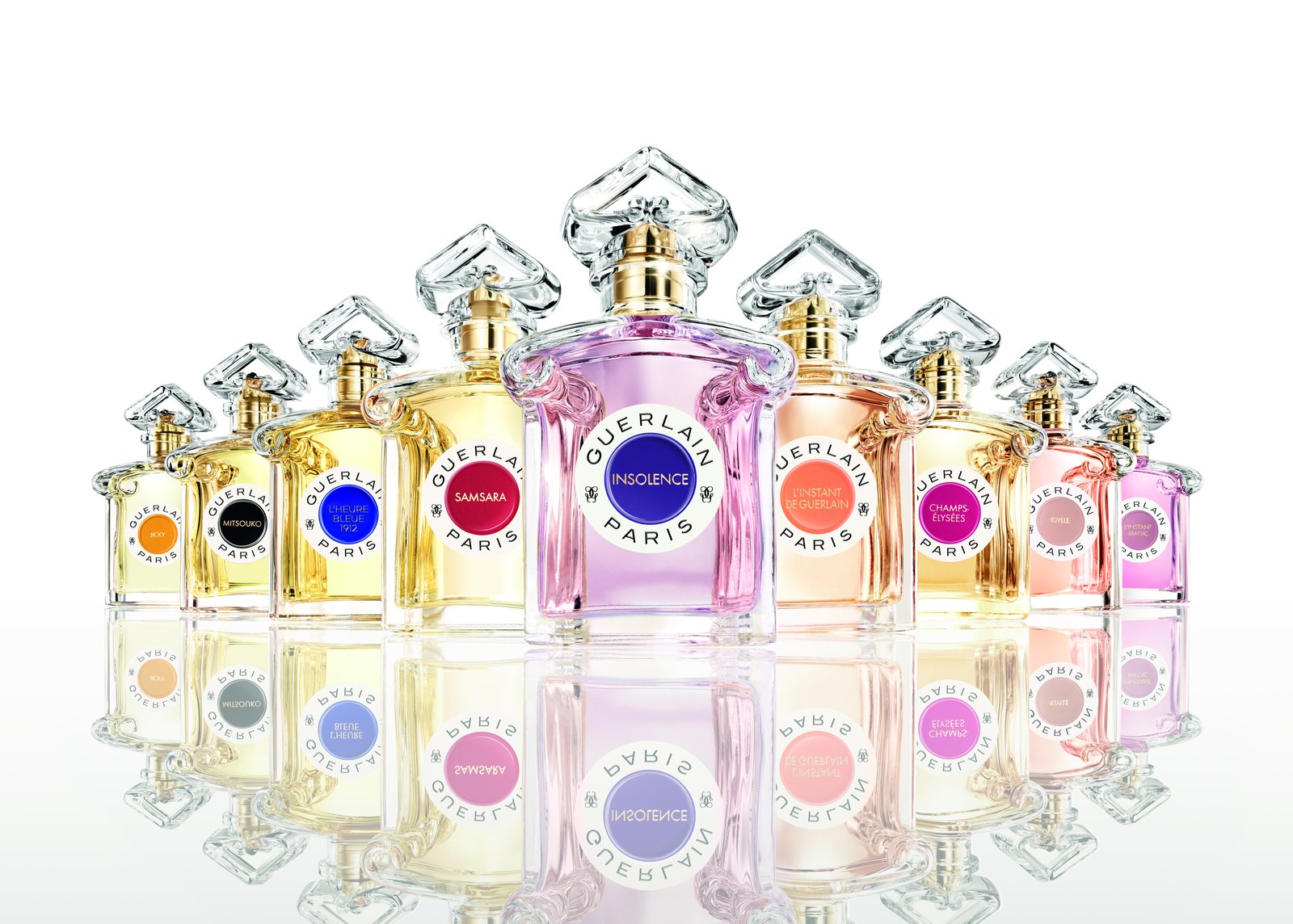
Quick answers
History of the house
Guerlain was founded in 1828 in Paris (France) by Pierre-Francois-Pascal Guerlain, a perfumer-chemist from Abbeville in Picardy (France). His first boutique opened on rue de Rivoli at the Hotel Meurice, in the 1st arrondissement of Paris. He sold soaps, powders, cosmetics and bespoke compositions to an aristocratic clientele. In 1853, he composed the Eau de Cologne Imperiale for Empress Eugenie, wife of Napoleon III, which earned him the title of patented perfumer to Her Majesty and established the early reputation of the house.
After the founder's death in 1864, his sons Aime Guerlain and Gabriel Guerlain took over the business. Aime led the olfactory direction and signed Jicky in 1889, the first composition to combine natural materials with synthetic molecules. Specialist fragrance press, alongside the Société Française des Parfumeurs, considers Jicky as the founding act of modern perfumery. Gabriel handled commercial administration.
From 1897 onward, Jacques Guerlain, Aime's nephew and the third perfumer of the house, composed a catalogue that became the reference of historic French perfumery. He signed L'Heure Bleue (1912), Mitsouko (1919), Shalimar (1925) and Vol de Nuit (1933). In 1921, he formalized the Guerlinade, the house signature accord built around half a dozen materials, which recurs across the major Guerlain compositions.
The olfactory direction then passed to Jean-Paul Guerlain, Jacques' grandson, from the late 1950s. He composed Vetiver (1959), Habit Rouge (1965), Chamade (1969), Nahema (1979) and Samsara (1989), alongside a large body of masculine releases that extend the family tradition. He is the fourth and last Guerlain family perfumer to lead the house.
In 1994, the Guerlain family sold 58.9% of the capital to the LVMH group through Christian Dior, then the remaining shares in 1996. The house became a subsidiary of the world's leading luxury group, while keeping its Paris operations intact. Jean-Paul Guerlain progressively stepped back from creative direction and remained a consultant. In May 2008, Thierry Wasser, a Swiss perfumer trained at Firmenich, was named Director of Perfume Creation. He became the fifth in-house perfumer of the house and the first who does not belong to the Guerlain family, signing the majority of new releases since, including Tonka Imperiale (2010) within L'Art et la Matière, the niche collection of the house launched in 2005, exclusive to Guerlain boutiques and the official website.
L'Art et la Matière, the niche collection of Guerlain
Launched in 2005 for the reopening of the historic boutique at 68 avenue des Champs-Elysees in Paris, L'Art et la Matière is the haute parfumerie collection of Guerlain. It stands apart from the wide-audience pillars of the house, from Shalimar to La Petite Robe Noire, through an author-led approach centred on a single elevated raw material. The collection is sold only through Guerlain boutiques and the official website, which made it one of the earliest confidential lines created by a major French house.
The name plays on the French expression "l'art et la maniere", and it captures the intent of the series: to turn a raw material into the subject of an entire composition. Each fragrance is organised around one highlighted ingredient, treated as a theme rather than as a supporting note. The collection has been reorganised and reformatted several times since launch, presented in a dedicated guise distinct from the emblematic flacons of the house.
The founding compositions of 2005 bring together Cuir Beluga, signed by Olivier Polge before he joined Chanel, Rose Barbare, signed by Francis Kurkdjian, and Angelique Noire, signed by Daniela Andrier. The series then grew with Bois d'Armenie, composed by Annick Menardo in 2006, Iris Ganache in 2007, and Tonka Imperiale in 2010, the seventh perfume of the collection, the last two signed by Thierry Wasser.
The collection first drew on established external perfumers, before being gradually brought in-house. Thierry Wasser, in-house perfumer since 2008, signs and oversees its recent developments, in continuity with the Guerlain tradition and the Guerlinade. The artistic and heritage direction of the collection is today led by Ann-Caroline Prazan, who heads art, culture and heritage at the house. L'Art et la Matière remains the freest creative space of Guerlain, and it is through this collection that the house asserts its place in niche perfumery.
Notable perfumes
The Guerlain catalogue brings together over a thousand references across nearly two hundred years. The following eleven historic compositions structure the identity of the house.
| Year | Perfume | Perfumer | Olfactory family |
|---|---|---|---|
| 1853 | Eau de Cologne Imperiale | Pierre-Francois-Pascal Guerlain | Hesperidic cologne |
| 1889 | Jicky | Aime Guerlain | Ambery fougere |
| 1912 | L'Heure Bleue | Jacques Guerlain | Floral oriental powdery |
| 1919 | Mitsouko | Jacques Guerlain | Fruity chypre |
| 1925 | Shalimar | Jacques Guerlain | Oriental vanilla |
| 1933 | Vol de Nuit | Jacques Guerlain | Green woody |
| 1959 | Vetiver | Jean-Paul Guerlain | Woody vetiver |
| 1965 | Habit Rouge | Jean-Paul Guerlain | Hesperidic oriental |
| 1989 | Samsara | Jean-Paul Guerlain | Floral woody sandalwood |
| 2003 | L’Instant de Guerlain | Maurice Roucel | Floral oriental magnolia |
| 2010 | Tonka Imperiale | Thierry Wasser | Oriental gourmand |
Olfactory signature
The Guerlain olfactory signature is organized around an internal accord, the Guerlinade, formalized by Jacques Guerlain in 1921. It is a base accord rather than a perfume of its own, traditionally built on six materials: bergamot, rose, jasmine, iris, tonka bean and vanilla, sometimes extended with civet in older formulas. This aromatic base runs as a connective thread through Jicky, L'Heure Bleue, Shalimar, Mitsouko, Vol de Nuit and their descendants. It gives the house a recognizable olfactory timbre even to an untrained nose.
Beyond the Guerlinade, the house has held several stable stylistic positions across two centuries. Bourbon vanilla is used in generous doses, particularly in Shalimar, which set the global code for the material. Iris, a cold and costly material, structures powdery compositions such as L'Heure Bleue. Hesperidic notes open nearly every Guerlain perfume, a direct inheritance from the Eau de Cologne Imperiale of 1853. Balsamic resins, tonka beans and Peru balsam give the bases the warm density that distinguishes Guerlain from Chanel or Caron.
Within the cartography of historic French perfumery, Guerlain stands alongside Houbigant, Caron and Coty as a foundational house. Three olfactory families were anchored in the catalogue: the modern fougere with Jicky, the fruity chypre with Mitsouko, and the oriental vanilla with Shalimar. These three compositions are routinely listed among the absolute classics of twentieth-century French perfumery in English-language fragrance criticism.
A historic French perfume house held by four generations of family perfumers, anchored in Paris and recognized by the Guerlinade signature.
Key characteristics
Frequently asked questions
Sources
- Guerlain: official Creators page, in-house perfumer succession (accessed 22 May 2026)
- Wikipedia: Guerlain (accessed 22 May 2026)
- Wikipedia: Jacques Guerlain (accessed 22 May 2026)
- Wikipedia: Thierry Wasser (accessed 22 May 2026)
- Fragrantica: Guerlain designer page (accessed 22 May 2026)
- Now Smell This: Jacques Guerlain (accessed 22 May 2026)
- Now Smell This: Thierry Wasser (accessed 22 May 2026)
- The Perfume Society: Guerlain house profile (accessed 22 May 2026)