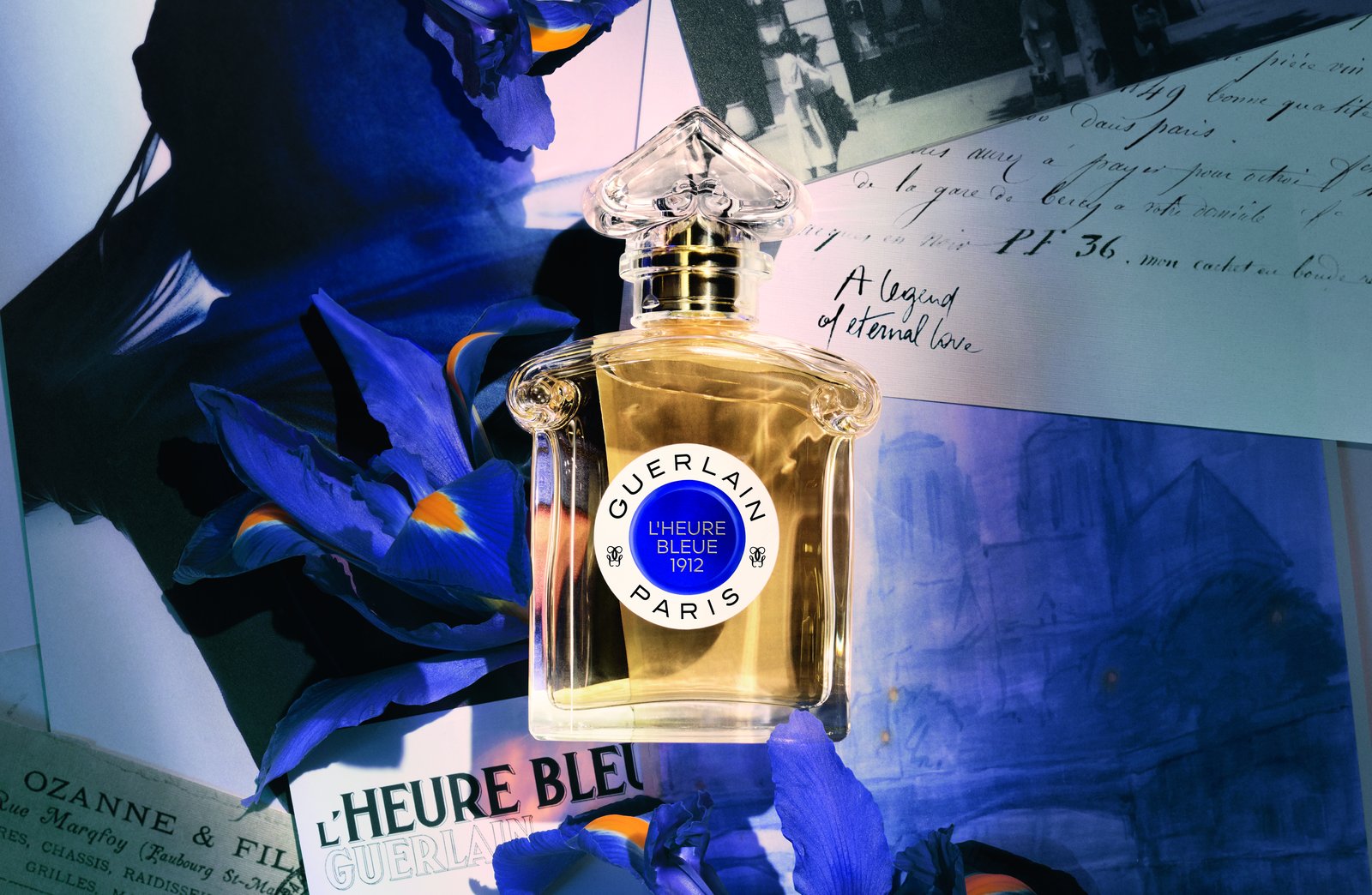
A 1912 launch that bet on melancholy
By the time Jacques Guerlain finished L'Heure Bleue in 1912, the American department store market was buying bright florals from Coty, Houbigant and Caron, mostly in the rose and violet register. Guerlain went the other way. He committed to a slow, twilight register, named after a moment in late evening when Parisian light turns blue. The reference image, often repeated in English-language Guerlain profiles, is of an early evening walk along the Seine where the perfumer described an atmosphere of suspended quiet.
What carries the perfume into US niche conversation is not the romantic origin story but the formal decision behind it. L'Heure Bleue is not built around a flower or a raw material. It is built around an atmosphere, which is a fairly avant-garde brief for 1912. American perfume writers covering the centennial in 2012 leaned into this framing because it explains why the fragrance reads as conceptually modern even though the materials in the formula are over a century old.
The historical timing also matters to the American reading of the piece. 1912 is the year the Titanic went down on the night of April 14 to 15, an event that registered deeply in US cultural memory and still shapes how Americans imagine the late Belle Epoque. Two years after L'Heure Bleue launched, World War I would close that era for good. By the 1920s, American buyers were reading the perfume as the last piece of a vanished pre-war Europe, which is part of why it gained a steady following on US heritage perfumery shelves.
The house lineage matters too. By 1912 Jacques Guerlain had been signing perfumes for a decade. He represented the third working generation at Guerlain, after Pierre-Francois-Pascal who founded the house in 1828 and Aime Guerlain who signed Jicky in 1889. Twenty-three years separate Jicky from L'Heure Bleue, and Jacques had already produced Voilà pourquoi j'aimais Rosine in 1900, Apres l'Ondee in 1906 and Rue de la Paix in 1908. L'Heure Bleue arrived as the work of an established author, not as a debut.
A floral oriental powdery built by accumulation
The pyramid, as documented by a specialist perfume site and un forum spécialisé, runs heavy across all three tiers. The top stacks anise, neroli, coriander, bergamot and lemon. The heart layers heliotrope, carnation, violet, clove, neroli, ylang-ylang, Bulgarian rose, jasmine, orchid and tuberose. The base sits on iris, vanilla, benzoin, sandalwood, tonka bean, musk and vetiver. The list is crowded, yet the impression on the skin is creamy and powdery rather than busy.
This density is part of what makes L'Heure Bleue a Jacques Guerlain signature. Where contemporary American niche perfumery often strips down to one or two raw materials, as Frederic Malle or D.S. & Durga frequently do, pre-war French perfumery worked by layering. L'Heure Bleue carries that approach. Each material reads as one element among many, and the perfume builds its effect through the sum rather than through any single soloist. Sylvaine Delacourte, former Guerlain creative director, has compared the method to Impressionist painting, with each material acting as a brushstroke.
The classification of L'Heure Bleue as a floral oriental powdery is consistent across every reference taxonomy used in the US niche space, from the Michael Edwards system to a specialist perfume site's own categories. The floral comes from violet, heliotrope and orange blossom in the heart. The oriental comes from vanilla, benzoin, tonka and musk in the base. The powdery effect comes from where the iris in the base meets the heliotrope in the heart, producing a rice-powder texture American perfume writers usually translate as a makeup or face-powder note. That texture is the perfume's clearest identifier on skin.
What surprises modern American noses on a first wear is the structure of the opening. Most florals built today move from light citrus to a heart and then to a base. L'Heure Bleue opens on a burst of anise, which puts it closer to a 1910s herbal apothecary than to a contemporary floral. The transition to the heart happens fast, the powder settles within minutes, and the perfume sets into an almost linear sustain that runs for hours without a clean phase break. That slow, almost motionless profile is one of the reasons collectors describe it as a meditative wear.
Heliotropin and anise as scent technology
L'Heure Bleue's structural turn rests on two materials that had not been used at this scale in commercial perfumery before. The first is heliotropin, also called piperonal, a synthetic molecule first isolated in 1869 by the chemists Fittig and Mielck from sassafras and safrole. American flavor and fragrance labs adopted heliotropin early for its powdery almond-and-cherry character, which approximates the smell of the heliotrope flower without literally copying it. The material is what gives L'Heure Bleue its instantly recognizable rice-powder and almond-paste sillage.
Using heliotropin as a dominant heart note was a sharp break from 1912 practice. Most pre-war compositions used the molecule sparingly as a side note. Jacques Guerlain treated it as a lead, paired it with iris in the base, and produced a powdery accord that an entire generation of perfumers would later imitate. Within Guerlain itself, the same accord came back in Shalimar in 1925 and in Habit Rouge in 1965, where heliotropin remains a stable component of the Guerlinade, the house identity accord Jacques Guerlain finalized in the 1920s.
The second move is the anise in the opening. Green anise or star anise oil delivers a slightly sweet, slightly warm herbal note that did not belong to the sunny citrus register American women's perfumes were built around in the 1910s. Set against heliotropin and base vanilla, the anise produces an almost pastry-like quality that anticipates by nearly a century the gourmand wave US perfumery would embrace from the 1990s on. L'Heure Bleue is in that sense an early gourmand that never names itself as such, and keeps a more formal posture than any later gourmand release.
The heliotropin-anise pairing resolves into a base of vanilla, benzoin, tonka and iris. That powdery oriental base, by then standard in the Guerlain idiom, supplies a warm amber depth that balances the herbal opening and the sweetness from the heliotropin. The result is a deeply harmonic perfume whose phases blend rather than separate, unfolding on the skin as one extended held note. The unity of tone recalls late 19th-century perfumery, but the palette of materials is considerably wider.
The Bouchon Coeur, Baccarat and US collectors
The historical extrait bottle, the Bouchon Coeur, was designed in 1912 by Raymond Guerlain, Jacques's cousin, with the crystal house Baccarat. The bottle pairs a heavy crystal body with a hollow stopper carved as an inverted heart, a first for the glass industry. The stopper is framed by scrolled details typical of late Art Nouveau, which dates the object to a precise design moment.
The Bouchon Coeur was not designed exclusively for L'Heure Bleue. From 1912, it also held the extrait of Fol Arome, launched that same year, and then Mitsouko from 1919. The heart shape worked as a shared marker of Guerlain haute parfumerie at the time. In American collector memory, however, the bottle stays attached to L'Heure Bleue specifically, because the 1912 launch was the first commercial use of the design and the image stuck.
L'Heure Bleue has also appeared in the Quadrilobe bottle, a form Guerlain created in 1908 for the fragrance Rue de la Paix and reused later. The Quadrilobe takes its name from the four-lobed stopper, carved from a single block of crystal. The form reads older, closer to a 19th-century cologne than to an author perfume, and Guerlain has typically reserved it for the cologne and eau de toilette concentrations of L'Heure Bleue rather than for the extrait.
The two-bottle setup, Bouchon Coeur and Quadrilobe, places L'Heure Bleue inside the broader family of identity flacons that defines Guerlain on the US vintage market. Baccarat, founded in 1764 in Lorraine, supplied most of the major Parisian perfumers of the period. The Baccarat mark, visible on the underside of original L'Heure Bleue bottles, is one of the things American auction houses check first, and it is what drives prices on rare extrait flacons whether or not the bottle still holds juice.
English-language critical standing
The immediate 1912 reception is hard to track in detail because the structured perfume press did not yet exist in either France or the US. What the Guerlain archives confirm is steady commercial uptake from the launch year, driven by Parisian buyers and by distribution through the major European capitals. The fragrance kept selling through the First World War without a production stop and grew into a Guerlain catalog pillar across the interwar years, including a quiet but steady presence in American department stores.
The English-language critical standing built up slowly across the 20th century. Reference voices in US niche writing such as Luca Turin and Tania Sanchez have praised the formula across multiple editions of Perfumes: The Guide. Octavian Coifan covers it regularly on 1000 Fragrances. The composition is consistently named in any American top-ten of all-time perfumery, usually alongside Jicky, Shalimar, Mitsouko and Chanel N°5.
The creative downstream is also substantial. The powdery heliotropin-and-iris accord L'Heure Bleue introduced in 1912 keeps showing up across the next century. Caron Pour un Homme in 1934 picks it up. Dior Hypnotic Poison in 1998 picks it up in a louder register. Serge Lutens Datura Noir in 2001 and Frederic Malle L'Eau d'Hiver in 2003 both replay it in different directions. Each owes something to the original gesture, and US niche reviewers routinely cite the lineage when they cover the newer releases.
The perfume also has a cultural life outside fragrance. It is referenced in 20th-century French literature, picked up by Colette in her writing on perfume, and folded into US-published Belle Epoque biographies as a sensory shorthand. It sits in the collections of the Musee international de la Parfumerie in Grasse and the Musee des Arts decoratifs in Paris. Museum status gives L'Heure Bleue a second life as a documented heritage object, separate from its ongoing commercial run.
IFRA reformulations and Les Legendaires
Like any heritage fragrance in continuous production for over a century, L'Heure Bleue has been reformulated several times. The drivers are familiar to US niche readers. The first is IFRA regulation, which has tightened restrictions on natural materials such as oakmoss and certain aldehydes for allergen and toxicology reasons. The second is raw material supply, since several naturals in the original formula have become harder to source at industrial volume.
Contemporary L'Heure Bleue therefore differs noticeably from the vintage versions sold in the 1920s through the 1960s. American vintage collectors and the a specialist perfume site community track the differences in detail. The most cited shifts are a thinner iris and a quieter anise in post-2000 versions. These changes do not erase the perfume's identity, but they do shift how it reads for noses who started with the older bottles, which is part of why US vintage L'Heure Bleue continues to trade well on eBay and at smaller auction houses.
In 2021, Guerlain repositioned L'Heure Bleue inside a heritage collection called Les Legendaires. The line gathers several pieces composed by five generations of Guerlain perfumers, presented in the original Bouchon Coeur flacon and accompanied by editorial copy that frames each fragrance in its historical context. The 2021 eau de parfum and eau de toilette have been described in American niche reviews as less dense, fresher and more transparent than the early-2000s versions, in a declared move to align the contemporary formula with the better vintage samples.
Repositioning founding pieces inside a dedicated heritage collection has become the default move at major historic houses. Guerlain's Les Legendaires sits in the same strategic slot as Chanel's Les Exclusifs and Cartier's Les Heures. The collection format protects the heritage compositions from a thinner mass-market distribution and gives them retail framing aligned with their commercial value. More than a hundred and ten years after launch, L'Heure Bleue is still sold through the Guerlain US site as the work of a master perfumer who built an industry milestone around an unusual idea: that a perfume could be about a quality of light rather than about a flower.
See also
Sources
- Guerlain: L'Heure Bleue 100th anniversary, Baccarat Gripoix bottle (accessed June 5, 2026)
- Guerlain: Les Légendaires L'Heure Bleue Eau de Toilette (accessed June 5, 2026)
- Fragrantica: L'Heure Bleue Eau de Parfum 1912
- Fragrantica: L'Heure Bleue Extract 1912
- Basenotes: L'Heure Bleue Eau de Parfum, detailed fiche
- Sylvaine Delacourte: L'Heure Bleue by Guerlain, History of a Mystic Perfume
- Elisabeth de Feydeau: L'Heure Bleue de Guerlain a 100 ans (2012)
- Fragrantica: L'Heure Bleue, Eternal Twilight by Guerlain
- Fragrantica Club: Was L'Heure Bleue reformulated?
- Auparfum: L'Heure Bleue, Guerlain fiche
- Olfastory: composition of L'Heure Bleue
- Perfume Intelligence: Bottle Designers, Guerlain Flaçons